Enquête dans le bois
A field guide in cards for life sciences: in pairs, you rebuild the food web of a wood.
In servicePlayed in classWhat it is
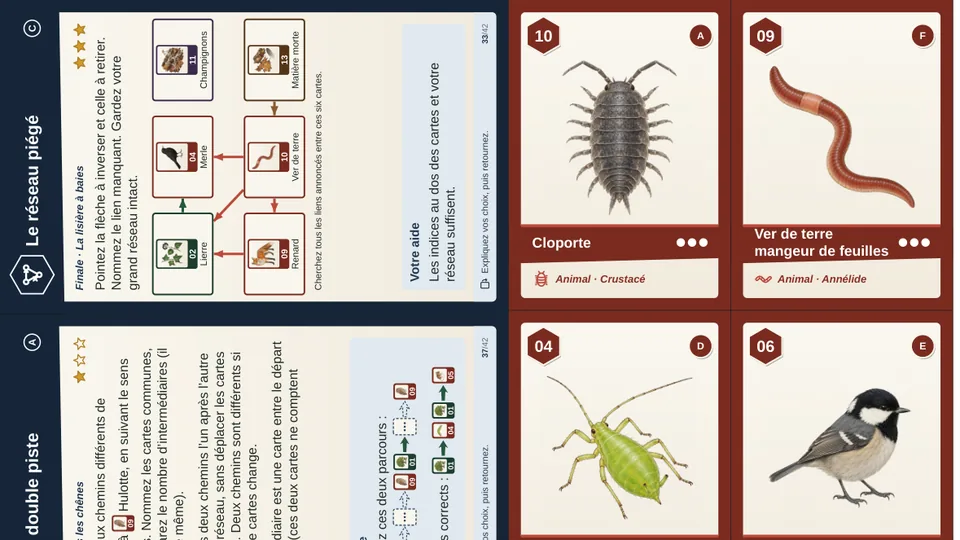
Enquête dans le bois is a card game for life and earth sciences in Year 7. Pairs rebuild a wood’s food web from illustrated cards, each with written clues, then reason about what changes when a disturbance occurs. The game exists in two forms: a forty-minute session with six cards, a pupil sheet and an answer key, and a box of several different woods, with three levels of help and four finales. I have had it played in class.
How it works
The pieces are field guide sheets, as in modern naturalist board games. Colour gives the kingdom (green for plants, red for animals, purple for fungi, blue for bacteria, brown for dead matter), the icon gives the group. On the back, what the card eats appears in miniature, and each miniature is bitten in the way the species feeds: a jaw for a mammal, beak pecks for a bird, caterpillar arcs for an insect. Arrows are laid between cards, and each one is justified.
The box is made from code: a Python program composes each face, Typst lays it out with a single typeface, Liberation Sans, and the build checks that the backs line up behind the fronts before printing on A3 sheets. A screen version also exists, on the game table where I bring together my other card games.
Why it exists
I did not want a busy look. I had first drawn an ornate board game, with gilding and ribbons, and I dropped it for plain cards, on plain paper, where a colour and an icon are enough to classify a living thing. A card read on its own must carry what is needed to play, and no information is written twice on the same face.
The texts follow the same demand: the clue sentences are short and natural, and images are never distorted. In a text, a card is represented by its miniature whenever space allows, rather than by a number.