Atlas
A browser game of planets for learning geography and ecosystems, played with a class code.
In servicePlayed in classWhat it is
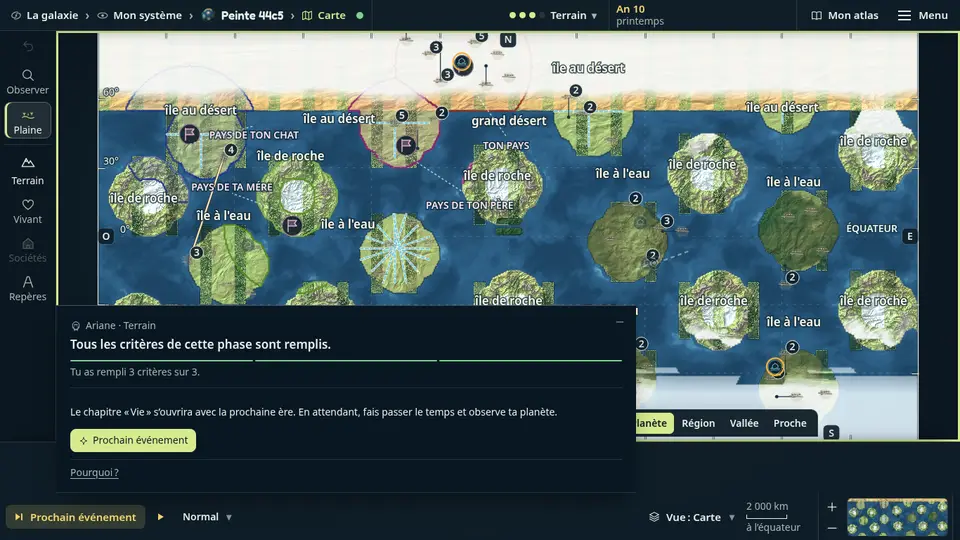
Atlas is a planet game played in the browser, at planetes.atecher.org. Each pupil aged 10 to 14 creates their own planet there: it takes shape under the brush, with its lands, its reliefs and its rivers, then fills with species. The game serves two curricula, geography (reading and making a map) and life and earth sciences (climate, ecosystems). You enter with a class code, with no account and no real name. My pupils play it in class.
Pupils still know it as Atelier des planètes, and Atlas is the name under which I am evolving it.
How it works
The planet is a grid that the simulation brings to life. Temperature depends on latitude and altitude, rain and seasons follow, rivers flow from the relief, and prey and predators balance, or do not. A species arrives only when its habitat suits it, then joins the naturalist’s notebook. Time advances on demand, with no timer, and a mistake has consequences in the world rather than a refusal on screen. You find your planet again with the class code and four symbols, because the room’s workstations wipe the browser’s memory at start-up.
The client is in JavaScript, with no runtime dependency, and every change is recorded by a Node server that keeps all versions. The whole is hosted on Vercel. I am now porting the game to my own engine, written in Rust: the simulation’s calculations must first reproduce identically those of the current version, and only then is the planet’s appearance reworked.
Why it exists
My pupils like painting and placing creatures, but they skip steps and get lost. So I moved the learning into the toy: species arrive when the habitat suits, visitors replace the task list, and classmates’ planets can be visited read-only. I wanted a calm, creative game, with no event that keeps interrupting. A volcano you have raised eventually erupts, and nothing happens without an action from the person playing.
Each era offers a number to push up, and the higher it goes, the better the planet: variety of habitats, biodiversity, well-being relative to footprint. It is never a stock of resources. Technology choices exclude one another, and the path not taken remains “the other path”, never a failure. Rewards are seen in the class gallery and are never ranked.