The algebra card game
A card duel in French for Year 9 and Year 10, where operations chain together like a calculation program.
In servicePlayed in classWhat it is
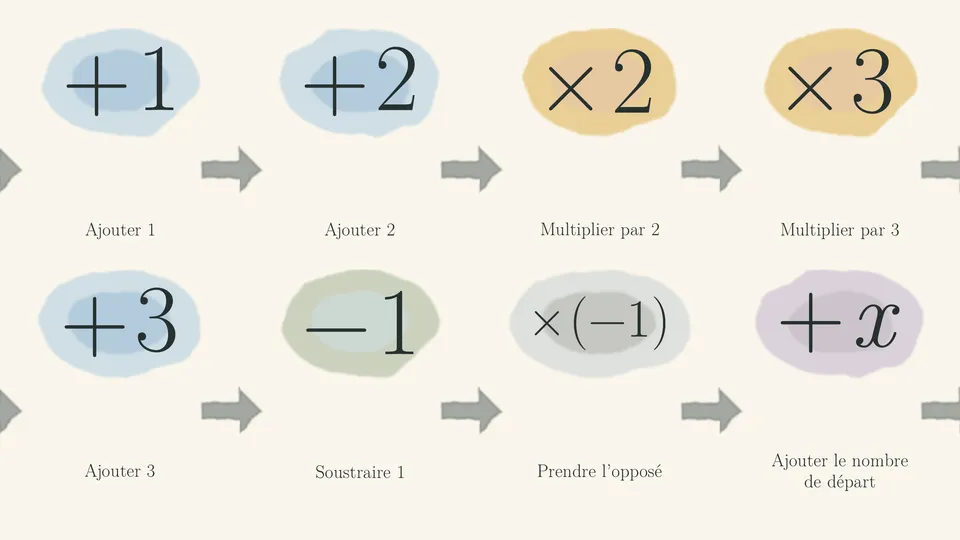
This is a two-player card game, in French, for Year 9 and Year 10 classes. Each card carries an operation, and laying cards side by side amounts to writing a calculation program: you start from a number and read off the result. The game leaves room for bluffing, because you can challenge what the other claims by answering with a counter-example. Its working title is Chaînes, and the final title is still to be set.
How it works
Operation cards are linked by an arrow painted across two cards, in a neutral colour so that each card’s colour keeps its meaning, that of the family of operations. Conjectures to check, characters and their powers complete the game. The fifty characters come from an earlier game. The words are those of lower secondary (starting number, result, counter-example) and the game terms are everyone’s (draw pile, discard, round), with no invented vocabulary.
The game prints as poker-size cards, cut from A4 sheets with their cutting marks, and is also played on screen on the game table, on two screens or one. The rules there are TypeScript functions, checked against the rules written in Python. A tutorial guides step by step, and two variants, Backwards and Secret Program, change the nature of the exercise.
Why it exists
My first La Fabrique game mixed deck building and worker placement. My simulations showed that deck building was almost useless and that you could win by going around the algebra. So I wrote a second game alongside the first, which does not replace it, so that the algebra can no longer be bypassed.
On the cards, each element is centred on its measured ink and not on its box, because an offset element looks unfinished. I rewrite a text that overflows rather than shrink it. The back is painted in watercolour: threads stretched over a ring of nails, on an indigo background.