Automated strategies in DeFi
A platform to build, simulate and monitor strategies as graphs of typed modules, without ever signing for you.
In progressPrivate betaWhat it is
This platform continues Yateli, the company I founded to make decentralised finance programmable without writing code (it is now inactive). It keeps Yateli’s promise: complex strategies that you compose endlessly, automate, connect to other services and watch at work. It keeps it with authority reduced to the strict minimum.
It is aimed at people who practise DeFi. You build a strategy, test it on simulated or historical prices, then monitor it and receive alerts. It is currently in private beta.
How it works
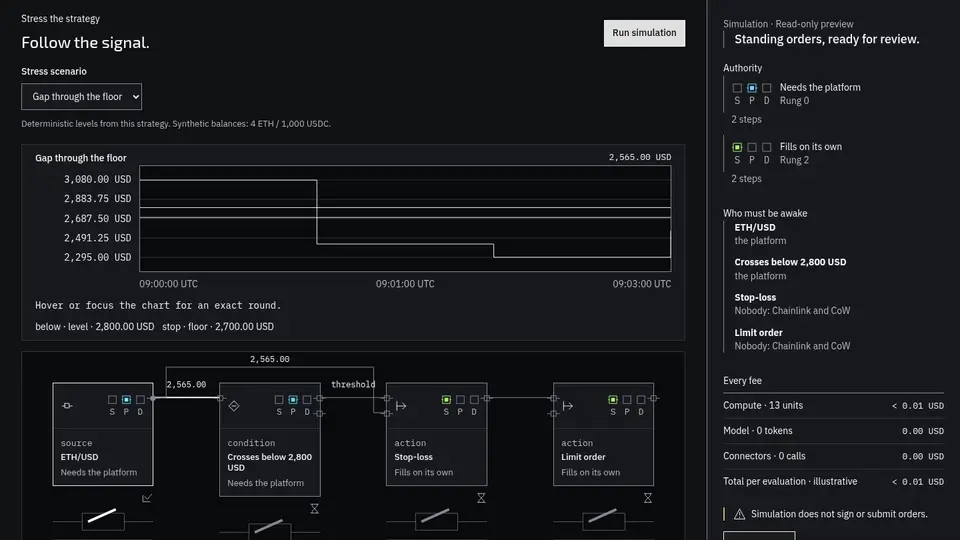
A strategy is a typed graph of modules. Each module declares its ports, its bounded parameters, the authorisation it requires, a pure step, its cost and its explanation, and a saved graph can in turn become a module. A visual editor lets you build, simulate, and monitor, while a plan and a sentence edit the same document. A , which reads neither clock nor network, runs the graph, so every simulation replays identically.
Each node shows the authorisation of its step, derived from the graph itself (watch, warn, standing order or delegation), and colour is used only to say so. This version prepares orders and stops at “this would ask for your signature”: it holds no key. A later version, being tried on a test network, has the person’s wallet sign before the order is sent to the CoW order book.
Why it exists
I took Yateli from zero to production, and I kept its promise rather than its code: its code, its contracts and its infrastructure are for me only lessons, and I started again from a blank page. So I set one constraint on everything automated here: hold only the authority the step needs, and be readable before being activated.
The core has been reviewed three times by tool-assisted security reviews, and every finding was fixed with a . The tests also run without any integration credentials, then without any network access, so that fallback behaviour is tested rather than assumed.