Courses and labs
My engineering courses, with textbook, platform, and corrections all drawn from one source, and the online Docker lab.
In serviceWhat it is
At EPSI in Bordeaux, from Bachelor 3 to Master’s 2, I teach engineering courses: Git and , Docker, cloud security, blockchain development. Each is delivered with everything that holds it up: the textbook, the learning platform, the forge for projects and the corrections, all drawn from one source. A school or a training centre can adopt a whole course and have it taught by its own team or by me.
The Docker lab is online, in French and English, and reserved for my cohorts: you enter through a class list, by receiving a sign-in link. A video will soon present it here, and an open demonstration will follow.
How it works
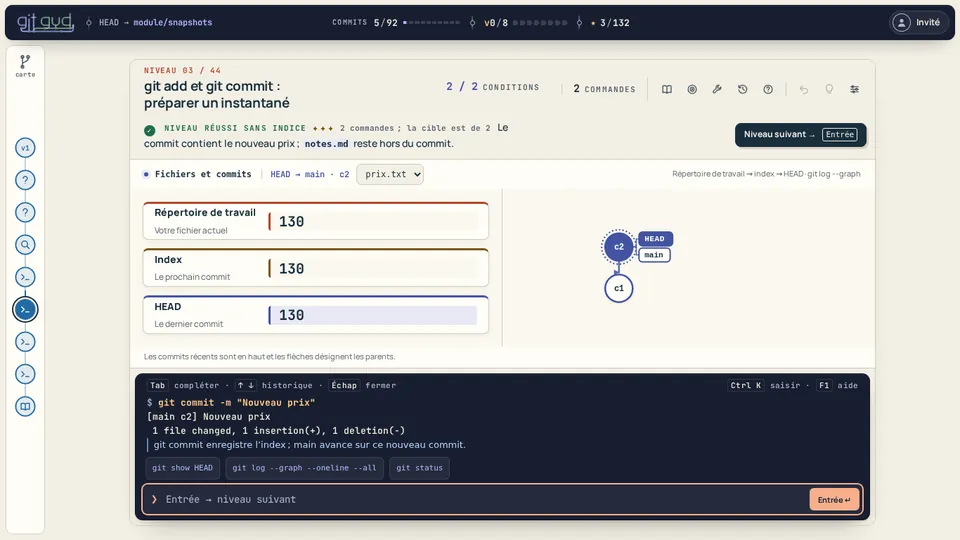
In Git and CI/CD, the whole course rests on a single case, from the first day to the last: the pricing of an electric vehicle charging operator. The textbook, the exercises, the bank of oral questions and the lab all share it, in Python as in TypeScript. gitGud, the course’s game, has you type real commands and shows what each one changes in the repository. Pairs then develop on my GitLab forge, where CI checks every change, and a dashboard shows me live who is moving ahead and who is stuck.
The Docker lab starts from a diagnostic of level, then unrolls modules and realistic incidents, each in two decisions (the diagnosis, then the intervention), with an explanation and an official source for every wrong choice. The setting is a container port run by cetaceans, where each object matches a Docker object. The terminal is a simulation that does not run Docker, and the final project calls for a real environment.
Why it exists
I wanted people to learn on real tools, and to be able to make mistakes without it costing them. The grade comes only from two individual live tests, and repositories and are not graded: you can start again without losing a point. That is what makes possible a course where you type real commands from the first day.
I rebuilt the Git course in the autumn around its single case, and that change touched every resource at once. Because the resources come from one source, the case changed everywhere without versions drifting apart, and that is why I offer a whole course rather than its pieces.